
Why White Belts Quit — Making Invisible Progress Visible
Walk into any BJJ gym in January and you'll see the mats packed. Walk in again in July and half of those faces are gone. The number gets thrown around so often it's almost folklore: roughly nine out of ten white belts never make it to blue. Judo, wrestling, and MMA tell the same story with different jackets. The dropout is not a coaching problem and it's not a talent problem. It's a feedback problem.
For the first eighteen months of training, almost nothing a beginner does looks like progress. They get tapped by the same people. They forget the technique they drilled on Tuesday by Thursday. Their coach moves on to the next student before they can ask the question they actually wanted to ask. The mat tells them nothing, the belt tells them nothing, and the voice in their head starts filling in the silence with the obvious conclusion: I'm not getting better.
Why People Actually Quit
Talk to anyone who walked away from a combat sport in their first two years and the reason is almost never "I didn't like it." It's something quieter than that.
They couldn't see themselves improving
Strength training has numbers on the bar. Running has a watch on the wrist. Grappling has a sixty-year-old purple belt smiling while he chokes you for the hundredth time. Without a measurable feedback loop, the brain defaults to "nothing is happening."
They had no map
A white belt watching open mat sees chaos. They don't know that the position they keep losing from has a name, that the escape has three steps, that the escape branches into two sweeps. Every roll feels like starting from scratch because they have no scaffold to hang the experience on.
Their coach is overworked
A head instructor running a class of thirty cannot give a single student detailed feedback on what they did in sparring last week, let alone remember it three months later. The student leaves the gym with no record of what was said and no way to revisit it.
They train inconsistently and don't realize it
"I go three times a week" usually means "I go twice some weeks and once others." Without tracking, the gap between perceived effort and actual effort widens until plateaus feel like failure rather than the obvious consequence of missing mat time.
They forget what they learn
Drill a technique once on a Monday and you'll retain maybe twenty percent of it by Friday. Without a way to log, revisit, and connect new techniques to the ones already in the toolbox, every class is a leaky bucket.
They have nowhere to put their game
A blue belt has a mental model — "I'm a half-guard player who chains to back takes." A white belt has a swarm of disconnected moves. They want a system. They don't have the tools to build one.
Making the Invisible Visible
After The Mat was built around a single conviction: if a student can see their development, they will stay long enough to actually have one.
Flowcharts — Give the Chaos a Shape
The flowchart builder lets a student lay out their game the way it actually exists in their head. Each node is a position, a transition, a submission, a video, or a coach's note — and edges connect them into the branching decision tree of an actual roll. A white belt who maps closed guard to scissor sweep to mount to armbar suddenly has a system instead of a list of moves. Three months later they add a branch. Six months later the chart has twenty nodes and they can see, in a way the belt around their waist will never show them, exactly how much bigger their game has gotten.
Here's what a developed game looks like inside the builder — a real chart you can pan, zoom, and click through:
That chart started the same way every chart does: one position node, one submission node, an edge between them. Closed guard sits at the center because that's where this player builds from. From there it branches — scissor sweep, pendulum sweep, hip bump, kimura trap, triangle, armbar — each branch a decision the player has actually trained for. Submissions are red, positions are blue, transitions sit in between, and video nodes embed the YouTube clip the player learned the move from. The whole thing is a memory you can read from across the room.
This is the antidote to "I don't know what I know." You know what's on the chart.
The Training Center — Numbers on the Bar
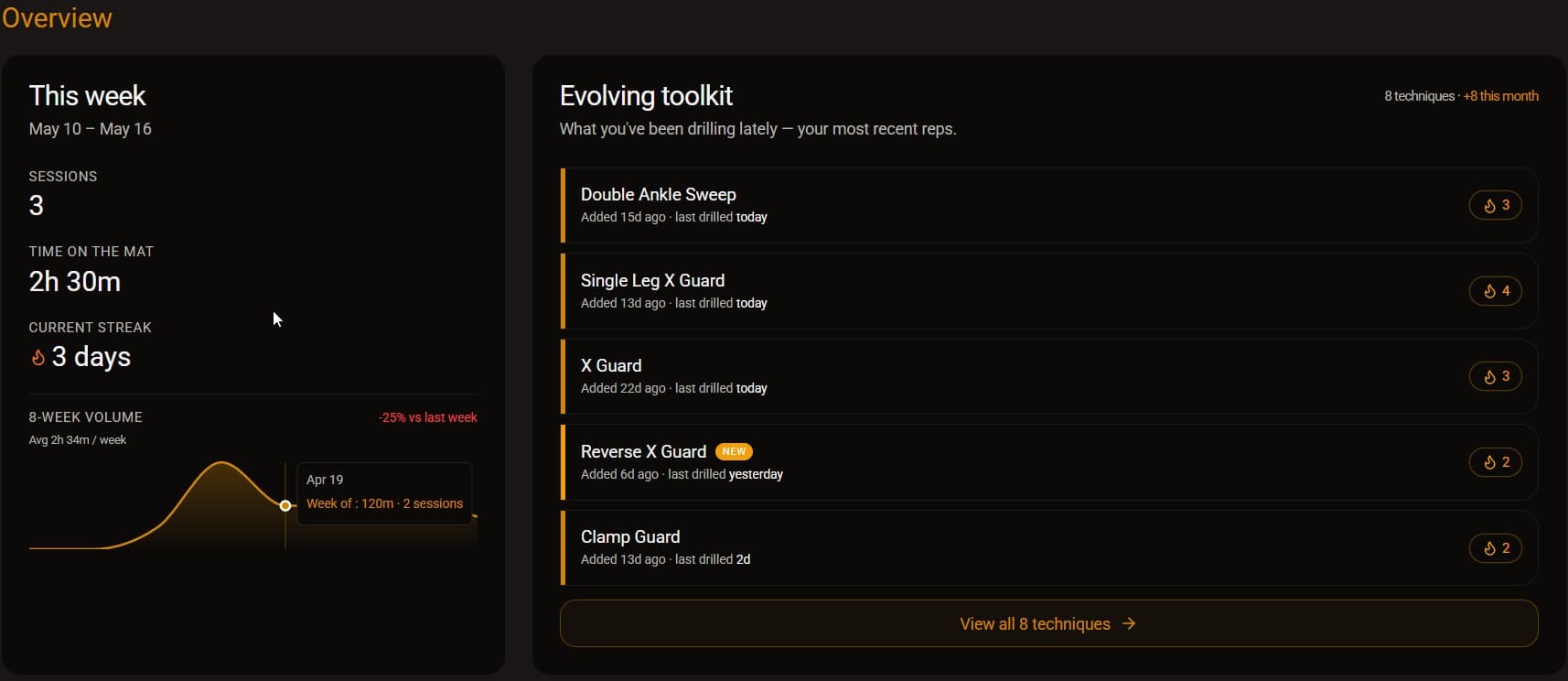
Every session logged — class, drilling, sparring, competition — with duration, type, rating, and notes. After a month the calendar tells the student something the mat never could: eleven sessions, six of them sparring, average self-rating climbed from a 5 to a 6.5. That is no longer a feeling. That is a graph.
The student who quits because "I'm not getting better" almost always trained less than they thought. The student who tracks finds out, and either trains more or accepts the plateau as math instead of failure.
Technique Library + Session Tagging — Stop the Leak
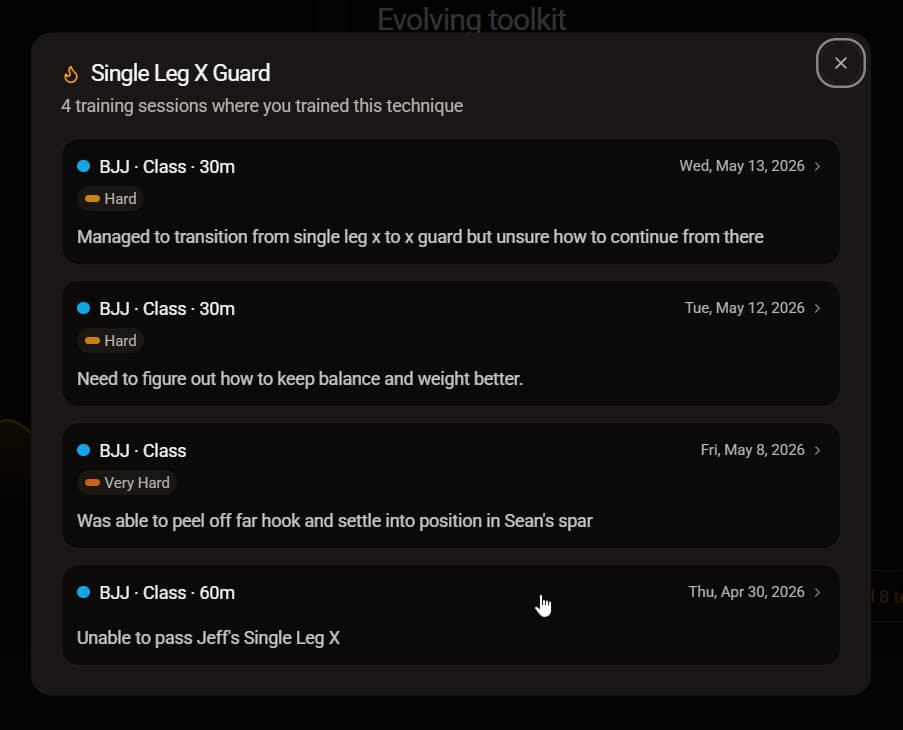
Tag each session with the techniques you covered. Six weeks later the platform tells you you've drilled the same kimura entry eleven times and have only seen the de la Riva sweep twice. The bucket stops leaking because you can see where the holes are.
When the white belt asks "what should I work on?" the honest answer used to be a shrug. Now the answer is in the data.
Video Review — Coaching That Persists
A student uploads a sparring clip. The coach scrubs to 0:42, drops a comment on the grip they keep giving up. Drops another at 1:18 on the hip escape that started too late. The student sees those notes whenever they want, forever. They can compare a clip from this month against one from six months ago and watch their own posture, framing, and pressure visibly change.
This is what coaching looks like when it isn't trapped inside one rushed conversation after class.
Training Plans and Workout Logs — Off-Mat Progress
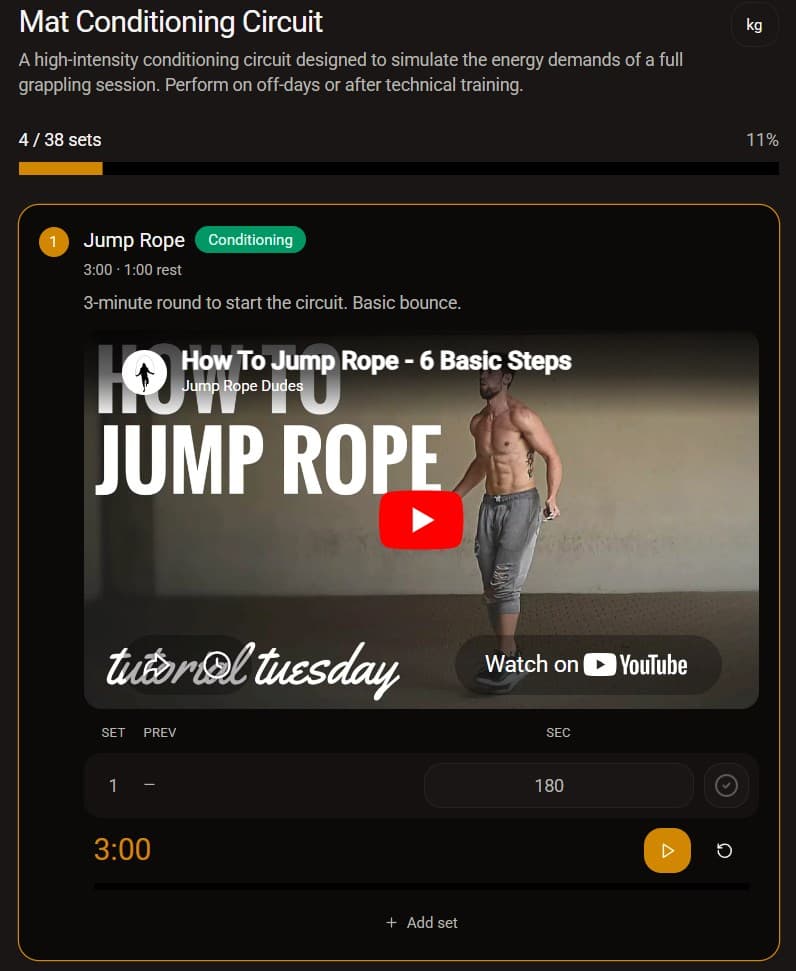
Coaches push structured plans — strength work, mobility, conditioning — with prescribed sets, reps, and weights. The student logs what they actually did. The gap between "the plan" and "what happened" becomes legible, and so does the strength curve underneath it. A white belt who couldn't see their jiu-jitsu improve can absolutely see their deadlift go up, and that win carries them through the months where the rolling feels flat.
Academy and Community — You Are Not Alone in the Tunnel
Every white belt thinks they're uniquely bad. They aren't, but they have no comparison set. Inside an academy on After The Mat, students see each other's flowcharts, training counts, and progress. Coaches see the whole roster's activity. The invisible becomes social — and the student who knows three teammates trained four times this week is a lot less likely to skip Thursday.
The Real Insight
The belt system was invented to solve exactly this problem and it doesn't, because the resolution is too coarse. Two years between promotions is six hundred training sessions of silence. Nobody can sustain motivation across six hundred sessions of silence.
What keeps people on the mat isn't talent or grit. It's a feedback loop short enough that the brain can register something happened today. A new node on the flowchart. A timestamp logged. A coach's comment on a clip. A rep added to the squat.
After The Mat exists because the difference between a white belt who quits at six months and a black belt at ten years is almost never the body. It's whether they could see themselves moving the entire way there.

Stop guessing. Make your training visible.
- Log every session — duration, techniques, rating, notes.
- Build your toolkit — every technique you tag, tracked over time.
- Map your game — flowcharts that turn a swarm of moves into a system.
- Get your tape reviewed — coaching that persists past class.